Posted on March 18, 2010 by Pat
Flying.
That being the case, Heroclix is lousy with flyers. To help them
do their thing on my gaming group’s 3-D maps (
here and
here), we use spiffy plastic flight stands…

They come in every size: one section high, two high, three high, etc.
They’re labeled, too. The less measuring or sizing up a player has to
do, the less of a hassle and the quicker the turns.
As for how I made ‘em, I didn’t. These are
waaay outside my
expertise, but luckily my buddy Davis has mad plastic skills. He cobbled
these badboys together in his secret lab and, well, I’ll let him
explain…
“They’re pretty easy to put together. The acrylics are
cut to size and shaped with a special saw blade made for cutting
plastics (cylindrical sections cut on a ban saw). The pieces
are then assembled with an acrylic solvent cement and…that’s it. Oh,
and don’t print any of that: let people think they’re hard to make so I
come off crazy talented.“
…oops.
Eh, it’s only on the internet. How many people could possibly read this?
On to flight stand house rules!
Flying
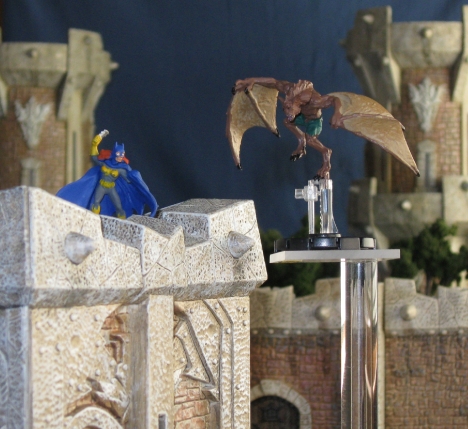
Let’s say you’re a lonely self-mutated abomination and you spot a
cute redhead on the roof. Do you take the stairs to say hello…? Nah,
walking is for suckers. Impress her by unfolding your monstrous leathery
wings and swooping down on her. ROMANCE!
So yeah, flying figures. The highest a figure can soar is three
sections more than the tallest point on the board. So if the tallest
building in play is six sections high, the max height a flyer can
achieve is nine sections. That lets a soaring figure pass safely over
the heads of any figures milling around that rooftop. When a figure’s
gotta go higher than our max flight stand (which is six), the stands
get stacked. That makes them extra wobbly, so be sure to bump the table
when reaching for your soda.
If a figure loses flight (or falls off elevated terrain), they
plummet to the ground and are dealt a point of damage for every section
dropped (figures falling only one section are dealt no damage). Figures
with combat reflexes, leap/climb or plasticity ignore fall damage, while
those with agility may roll to land safely. Defense modifiers like
toughness and invulnerability absorb any applicable damage. If a flying
figure is knocked out of the sky, they deliver light object damage to
any objects (or figures) unlucky enough to be on the bullseye below.
To help protect flyers, our house rule is that flight may not be
outwitted while in use. If a flyer is slumming it and just walking
around the battlefield, go ahead, outwit his flight. But if they’re in
mid-air…? Nope. The best you can hope for is to blast ‘em, deliver some
damage and hope they land on an “earthbound” click. The same rule
extends to figures using leap/climb, plasticity or super strength to
hang off the side of an elevated section: those powers may not be
outwitted while in use.
S’more house rules: If a figure with flying wants to take flight,
the simple action of taking off eats up one (1) movement. Same with
landing. Horizontal and diagonal movement is counted as normal BUT
vertical movement is free. That gives flyers a justified speed bonus:
flying guys can get to the top of a building a whole lot quicker than
the jabroni taking the stairs. And finally, airborne flyers may attack
ADJACENT non-flyers situated on an elevated level (like that
Batgirl/Man-Bat scene above).
Carrying Objects

More an aesthetic than anything else, flight stands can be used to
indicate when a figure is carrying an object (or another figure). And
you don’t have to be a flyer to use ‘em; ground guys like the Hulk or
Hourman can use flight stands one section high when lugging stuff
around. Here Gladiator shows off by simultaneously using TWO flight
stands before beating the Human Torch to death with a squad car.
If you haven’t read the issues of
Fantastic Four the above scene is based on, you’re missing out. Check out this cover…
…purple OMAC is freakin’ CRAZY!
It’s a two-part tale (FF #249 & #250) and it’s a high-water mark
for comic book brawls. It starts mean, gets rowdy and before the fight’s
over it’ll suck in the X-Men, Spidey and Captain America! Awesome,
awesome, awesome! They’re fairly cheap as back issues, plus I’m sure
they’ve been collected in a trade somewhere. I can’t recommended ‘em
enough.
A’ight, back to ‘Clix nonsense…
Mid-Air Tackle
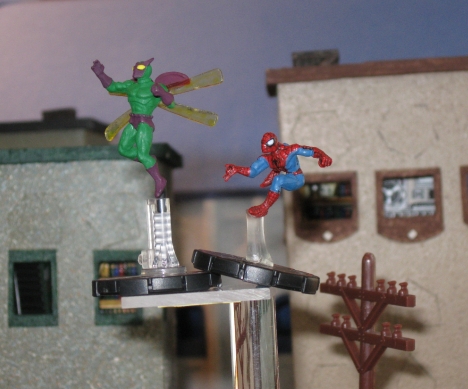
Um, kinda looks like Spidey is playing grabass with the Beetle, huh…?
Yeah, that’s not at all what I was going for. Or maybe it was. The
human subconscious is a dark and mysterious thing.
Anyway, if a flyer is being all Star Bellied Sneetch-like and lording
over non-flyers, you can still get up in their grill. A non-flying
figure with leap/climb, plasticity or combat reflexes may launch
themselves into the air and hitch a ride. Both figures then share the
same space and may swap close-combat attacks. If the flyer is successful
in an attack against his unwanted hitchhiker, his tagalong foe must
roll 2d6. On a roll of doubles, the piggyback ride comes to an end and
the hitcher drops like a rock. On the flipside, the hitchhiker can
pummel away without knocking his opponent out of arm’s reach.
A tackled flyer can still move around the board (at -2 speed), but
his tagalong “friend” moves with him. If a flyer in this predicament
lands, the hitcher is placed on an empty adjacent square (hitcher’s
choice). If two figures dog pile a flyer, all figures are immediately
grounded (without fall damage).
The final “tackle” house rule is my favorite. Here’s how it works:
say your teammate is a flyer and you want to make a long range attack
against the enemy figure clinging to him. You declare any modifiers
(like perplex or whatever), roll the attack and then make a second roll
(1d6) to see who you hit. See, since both figures are taking up the same
space (and, in theory, wrestling with each other), you don’t exactly
have a clear shot. Roll a 4-6 and you’re in the clear: you nail the
right target. Roll a 1-3…? Blast your teammate by mistake and hope
Hallmark has a card for that.
Vertical Barriers
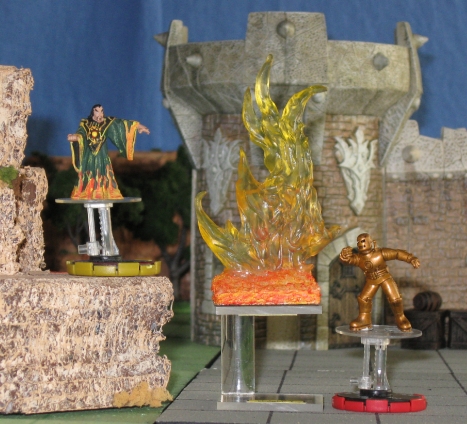
Dude, you shouldn’t even light a scented candle when you’re wearing
some droopy sleeved robe, let alone ignite fire barriers. Eh, I’m sure
the Mandarin knows what he’s doing. It’s not like supervillains ever
accidentally disfigure themselves and go batsh*t crazy.
Normally barriers are spread flat on the ground, but a 3-D board lets
you get more creative with their shape. With the help of flight stands,
barriers can be stacked up to four section high as a single pillar.
When a barrier is used this way, the entire length of the flight stand
is considered part of the barrier and features all of that barrier’s
properties.
More on custom barriers
here and
here.
Climbing

There’s a noise outside your window. You walk over, pull open the
drapes and there’s Grodd’s crotch pressed up against the glass. Welcome
to Central City. And good luck getting THAT mental image outta your
head.
So, got a pesky sniper up on a roof causing mischief…? A figure with
leap/climb, plasticity or super strength can scale the surface of any
structure. If a figure takes damage while hanging off the edge of a
building in this fashion, their controller rolls 2d6. If it comes up
doubles–ANY doubles–you lose your grip and that whistling sound will be
your butt heading south.
The flight stands work well and since my group play on an oversized
map, they don’t clutter the board too bad. That said, there are times
when we have a lot of players, everyone is playing flyers and the board
looks like a birthday cake with a dozen flight stand candles dotting the
landscape. Bumping the table when that’s the case leads to a
spectacular display of Heroclix dominoes and salty language.


